The Low CPC Myth: Why You Don't Need a Cheap Click
Most e-commerce owners look at CPC as the primary KPI. Wrong. We explain why a low CPC can destroy a campaign and which metrics to actually measure instead.
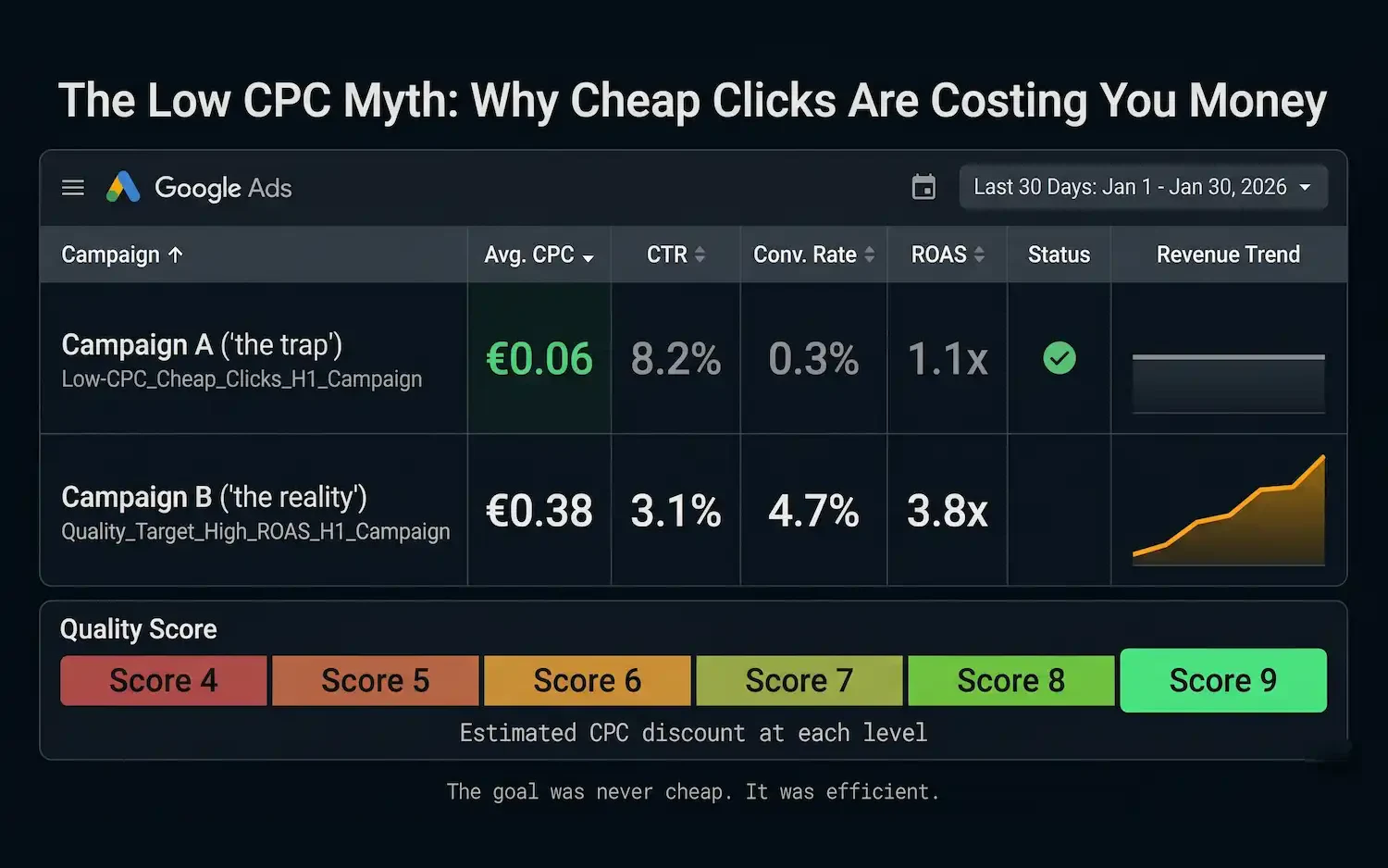
Why Low CPC is Deceptive
Intuition says: lower CPC = cheaper traffic = better campaign. In practice, that's almost never true. The Google Shopping auction rewards relevance, not cheapness. When you systematically optimize for the lowest possible CPC, the algorithm sends you traffic that can be bought cheaply — and that's in the vast majority of cases users who don't buy.
Concretely: Google Shopping CPC in 2026 averages between 0.66–0.71€ for e-commerce, but that average hides a huge distribution. Clicks at 0.20€ come from broad searches with no purchase intent. Clicks at 1.50€ come from users who are comparing specific models before buying. Those who think they're saving by choosing the first — pay more per conversion, not less.
What is the "Death Spiral" of Low CPC
This is the mechanism that often occurs when a campaign aggressively optimizes for low CPC:
- Step 1 — the campaign attracts cheap clicks from generic or unintentional searches
- Step 2 — those clicks don't convert, conversion rate drops, Google Quality Score worsens
- Step 3 — to maintain position, Google raises your bids on those weak terms, CPC rises — but traffic quality stays bad
- Step 4 — ROAS falls, budget is spent faster, profit shrinks while CPC still looks "ok" in the report
The result is that you pay more and more for worse and worse traffic, and the only metric masking it is the average CPC which stays low because the traffic is still cheap — just useless.
Which Metrics to Actually Measure
CPC is an input metric — it tells you how much you pay for entry, but nothing about what happens after the click. For e-commerce, the relevant metrics are exclusively those tied to revenue:
| Metric | What it measures | Healthy benchmark (2026) |
|---|---|---|
| ROAS | Revenue per euro spent on ads | 3–5× for prospecting; 5–10× for retargeting |
| Conversion Rate (CVR) | % of clicks that result in a purchase | 1.4–6.2% for Google Shopping |
| CPA | How much one conversion costs | 7–45€ depending on industry |
| AOV | Average order value | Defines how much CPA you can afford |
| CLV:CAC ratio | Customer lifetime value vs. acquisition cost | Minimum 3:1 for profitable growth |
How Feed Affects "Real" CPC
What few people understand: feed quality directly determines the CPC you get. The Google auction doesn't give the same CPC for the same bid to all merchants. A merchant with a precise title, correct GTIN, and high CTR pays less for the same position than a merchant with a generic feed — because their Quality Score is higher. Each Quality Score point brings about a 10% CPC reduction.
So instead of asking "how do I lower my CPC", the real question is: "how do I improve my feed so Google rewards my ads with lower CPC for high-converting traffic?" — that's the only path leading to lower CPC and higher ROAS simultaneously.
A Practical Test for Your Campaigns
Open your Google Ads report for the last 30 days. Sort product groups by CPC — ascending. Check the CVR for the group with the lowest CPC and the group with the highest. In 9 out of 10 cases, the group with higher CPC has 2–4× better CVR and better ROAS. That's counterintuitive, but consistently true.
Want to see how your feed stacks up?
Find out what CPC you can actually achieve without sacrificing conversions.
Want this kind of result on your store?
Request a free analysis