Why Feed Quality Matters More in 2026 Than Ever Before
Google AI Max is changing the rules. The 'set your bid and wait' approach no longer works. What you need to know about your feed before spending another euro.
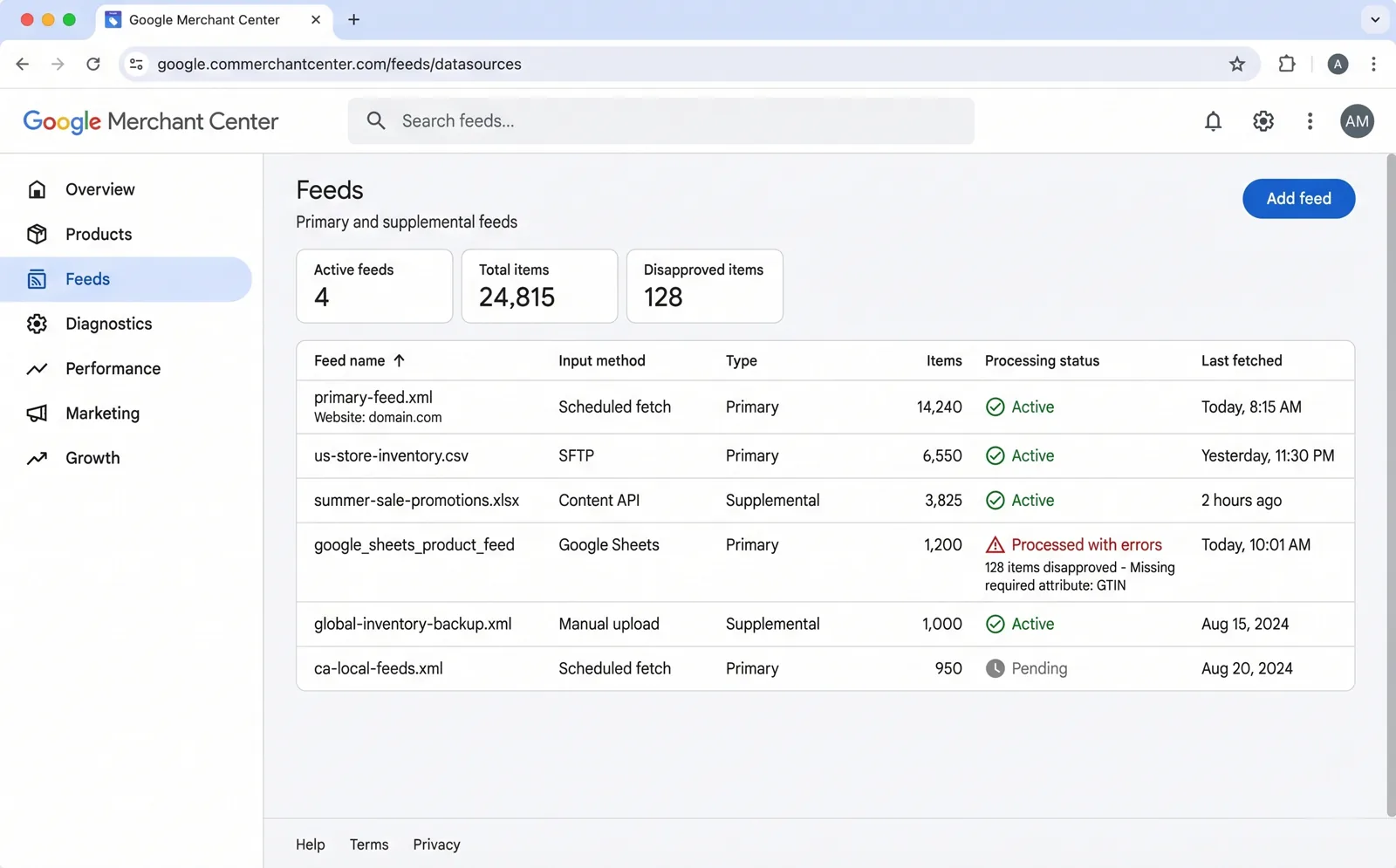
Google AI Max is changing the rules. The old "set your bid and wait" approach no longer works. Here's what you need to know about your feed before spending another euro.
In late 2025, Google quietly launched AI Max in beta for EU markets. The difference from classic Performance Max is not marketing spin — it's a fundamental architectural change that transforms how Google decides who sees your product. It looks less at your campaign history and more at the feed itself: how many attributes you have, how consistent they are, whether you can answer "I'm looking for X for Y in size Z".
In conversations with Serbian e-commerce owners spending €500–€5,000 per month on Shopping, we hear almost the same sentence: "Something changed in the last 3 months. CPC is rising, ROAS is falling, and we haven't changed anything." You haven't changed anything — and that's the problem. Google has.
What Specifically Changed in 2026
Three things, in order of importance:
- AI Max is taking share from Performance Max. At the start of 2026, AI Max gained priority in auctions for searches with high purchase intent signals. If your feed doesn't "say enough" — you simply don't appear in those auctions.
- Conversational Shopping is in pilot phase. In March, Google started testing conversational shopping in several EU markets, including Poland and Hungary. Serbia is not far behind. Conversational means: "I'm looking for a black leather jacket under €200, size M, with a zip." If your feed doesn't have attributes for material, color, size, and closure type — you're not in the game.
- Disapproval rules have been tightened. Attributes that were "warnings" a year ago are now "errors". Old feeds that worked for years are starting to get disqualified en masse.
Feed quality in 2026 is what page speed was for SEO in 2018: an invisible qualifier that decides whether Google even looks at you.
What This Means in Numbers
In Q1 2026, we audited 14 Serbian accounts. Average attribute completeness: 38%. Google recommends a minimum of 95% for a competitive auction position. Five of the 14 accounts had less than 30% — which technically means the AI Max algorithm treats them as "unknowns".
Those same companies were spending an average of €2,100 per month on Shopping campaigns, with ROAS between 1.6× and 2.4×. After 60 days of implementing bulk enrichment, ROAS averaged 3.1× — without increasing the budget, without changing the bidding strategy. We only changed the data.
So why don't agencies talk about this?
The most honest answer: because feed work isn't sexy. Bid management is sexy. Creative testing is sexy. But feed engineering is a spreadsheet, attribute mapping, writing regex rules for GTIN validation. Nobody makes an Instagram case study with nice numbers out of that.
The second reason is structural — most digital agencies in Serbia optimize for a retainer: the longer the "optimization" takes, the higher the monthly bill. Feed work is the opposite: do it right once, pay for maintenance. That doesn't suit agencies.
What to Do Now
If you recognize yourself here — the fastest diagnostic step is a free Feed Audit. We connect read-only to your Merchant Center, map every attribute of every SKU, and within 48 hours send you a PDF with a concrete list of what's missing, what's wrong, and what Google is ignoring.
Do you recognize yourself in this?
Request a free Feed Audit. No commitment, results in 48h.
Follow this blog for upcoming articles in the series: Feed Anatomy (47 attributes), GTIN and brand rules, AI Max readiness checklist.
Want this kind of result on your store?
Request a free analysis